Visual impairments can result from problems with any part of the visual system, including the eyes, eye muscles, optic nerve or areas of the cerebral cortex that process visual information (Book et. al). Because cerebral palsy frequently affects the visual system, children with CP are more likely to have visual problems than are other children. In fact, according to a study conducted by Black, "up to 75% of children with CP are impaired".
One such of these specific impairments is labelled cortical visual impairment. Cortical visual impairment or CVI results from injury to the brain's visual centres on the cerebral cortex (Book et. al). A child with CVI is thus able to pick up visual information with their eyes but the child's brain cannot process and interpret the information correctly. It is analogous to an imperfect computer chip which cannot fully process the input from the keyboard.
Generally speaking, the most common CVI symptoms presenting in children include an abnormal light responses, inconsistent visual responses to the same stimuli, and decreased responses to visual stimuli when auditory stimulation is present (Giord et. al). But the loss of vision does not only exhibit itself in symptoms directly related to the field.
When a child is blind they have lost one of their basic senses - they are under stimulated. Many of these children resort to other behaviours and forms of self stimulation to compensate for this under stimulation. These behaviours can include head banging, poking, rocking or staring at sources of light (Edelson). It has been reasoned that the head banging may even provide a form of pleasure related to movement titled kinaesthetic drive.
Though these behaviours can be a negative influence in many spheres, developmentally these behaviours are important for blind children as connections are made in the brain where the body is (Coots).
In fact, in the past two months I have witnessed the importance and predominance of these behaviors. In specific, one CVI-blind child at Hope Home fully engages in these actions, though there are two additional CVI children at the home.
However, though these children may seem lost in their world of behaviors that are difficult to comprehend - these children have NOT lost all of their senses: they still have viable feelings remaining. Most importantly, these remaining sensations need to be exercised to promote development. Presently, at Hope Home the developmental pursuits revolve around two core senses: sound and touch.
Stimulating the sense of sound is one experience that is constantly integrated into these children's lives. A variety of genres of music are being incessantly played on the stereo or sung. In addition, at times the children actively engage in creating their own music using instruments such as tambourines, bells, and drums. Therefore, not only to they to revel in the therapeutic auditory sensation but they also get to experience the tactile stimulation associated with banging ones hand against the firm surface of the percussion instrument.
Similar to the sense of sound, the sense of touch is almost effortlessly innervated into each of the three children's our times. In conjunction with the unintentional "touch" lessons, such as putting on clothes and feeding, toys such as a ball-pits and sensory boards provide opportunities to optimize each of these children's development.
Overall, though their condition has robbed their sight from them like a thief in the night - not all is lost. And this can be no more clearly than in this smile below.
Monday, December 1, 2014
Cerebral Palsy & Blindness (Stacey Braun)
Tuesday, November 25, 2014
A day at Wildflower Home
Last time I wrote about Chiang
Mai, this time, I´ll write about Wildflower Home, the place I work in. You may
have read a bit about my tasks there already, but the organisation itself might
not be familiar to you.
Wildflower Home is a
non-profit organisation that provides shelter for single mothers and pregnant
women. It is located a little outside of Chiang Mai in a rural context,
surrounded by fields. The foundation itself contains beside the main building
and the mother´s homes a day care for the older children and a small farm. The
whole complex is designed with passion and love, the columns of the main
building for example, are trees and all walls are painted with floral motives.
A lot of small channels and
lakes help to water the plants in the farm during the dry season and give the
whole area an idyllic outlook. It is truly a place to rest and recover, a place
of peace – at least for me. That doesn´t mean that things are always sunny at
Wildflower Home. It is like everywhere, you deal with the everyday life issues
as well as the sometimes hidden personal problems. And I have suffered enough
hours under the inclement sun fastening the soil around one of the ponds or
shipping rice husk for the stables to know that the so called “simple life” is
in the first place hard work and not simple at all. That it has nothing in
common with the romantic idea of being consistent with nature and yourself you
can find in many western societies. Still, I can imagine places to work in,
which are worse. Every time I take a break from work, sitting in the shadow
with my water bottle, with the beautiful view over the farm, the ponds and
banana trees, the stables and the vegetable garden, I do feel very privileged.
Privileged, because I am able to experiences this all, to see what we have done
and what is left to do, because I have the opportunity be a small part of this
organisation, joke with the other farm workers and just be thankful for a
moment of rest.
Now I am writing again about
my experiences here and you still don´t know more about Wildflower home. The
whole point of the organisation is to encourage the mothers and give shelter
for them and their kids as long as they need it. It is hard to write about “the
mothers”, each of their stories is different and not all of them shall be
shared in public. Their age varieties over almost twenty years, some have only
one child, some a lot, some only stay for a couple of days and some for years.
The only thing, that unifies them, is that they and their children are in
needs. Wildflower Home tries to find a solution of each and every one of them,
encourage them. For me as a volunteer this variety of needs means in the first
place to be very flexible and creative. I try everything what needs to be done
– you never know, you might be able to solve a problem if you just try. But it
means also, to except, that from time to time an expert is needed or just
someone, who is fluent in Thai.
Tuesday, November 18, 2014
More Than Just A Set of Wheels (Stacey Bruan)
According to the AARP, it is estimated that only 5-15% of
people who need wheelchairs actually have them. That means that spanning the
globe and its seven continents, as many as 350 million people are lacking the
support, accessibility and mobility that these devices provide.
In the year 1967, Joni Eareckson Tada became one such of
these persons who required a wheelchair. After misjudging the shallowness of
the water in Chesapeake Bay, Joni became a quadriplegic at 17 years of age.
Following years of struggle and rehabilitation, she founded an organization
called Joni and Friends.
Since the year 1979, Joni and Friends International
Disability has been dedicated to assisting people affected by disability and
those around them. One of the organizations means of doing this is through
their program called "Wheels for the World". As according to the
program's mission statement, this project "provides FREE wheelchairs to
children and adults affected by disability around the world".
As can be extrapolated by the immensity of that goal, this
is not a single link chain of delivery but instead it is a step-wise process.
Overall, it can be defined by the following steps: drop-off, transportation,
restoration and distribution.
Initially, donated chairs are dropped off at specified
locations. These chairs are given for a variety of reasons. Sometimes the
donor's condition has changed and they require a different chair or no chair at
all. Sometimes the donors outgrow their chairs. But regardless of the reason,
the chairs are collected. Following collection, the chairs are transported to
shipping ports. These ports serve as hubs where each piece of equipment is
routed to a different restoration centre.
Currently, "Wheels for the World" operates
restoration shops at correctional facilities across the United States. Inmates
are trained to restore the chairs to "like-new" conditions. After
each of the individual wheelchairs have been mended, they are shipped
internationally to various distribution centres. Interestingly, the Kingdom of
Thailand is one of these sites. Though
their movement spans the geographical range of the country, Chiang Mai is one
site within the country where dispersal occurs.
In fact, on November 11, 2014 I was on hand at an event that
occurred at Payap University's Faculty of Nursing. At this event, there were 3
special guests in the spotlight. Two of these guests were selected cerebral
palsy children from Hope Home and the third was a foster child affected by
Dushenes Muscular Dystrophy.
In a room filled with occupational therapists, physical
therapists and mechanics, each child was fitted with a new wheelchair. Firstly,
this process began with a subjective interview with the therapists gathering
information about the condition and lifestyle of each child. Questions posed
ranged from range of motion to the arrangement of each child's home.
Progressively, as increasing amounts of information was acquired, the focus was
shifted to a more objective view. During this time, measurements were taken.
For example, these tabulations included hip breadth and chest width.
Subsequently, it was these numbers that were used to determine specifications
such as the size of the seat and seat back. Lastly, once all sizes were
gathered, the appropriate chair was then selected and the mechanics then
altered each chair to fit the child as best as possible.
Though simply owning a wheelchair is imperative, having a
proper fitting wheelchair may be exponentially more important. A proper fitting
wheelchair can slow the rate of degenerative conditions, prevent scoliosis,
eliminate pressure sores and many other secondary disturbances. However, a
wheelchair is important for more than just its role as a sponge for medical
jargon.
The query of "what does a wheelchair mean to a person"
is impossible to intricately answer. Each individual is defined by a unique set
of circumstances and variables that would cause infinite variation in their
responses. Nevertheless, from an observational perspective I can generally
state that a wheelchair means so incredibly much.
A wheelchair can mean that a child previously unable to feed
without being physically held, now has increased independence and
self-actualization by feeding in the chair. A wheelchair can mean that a child
heavily impaired by hypo sensitivity now has an environment that accommodates
learning. A wheelchair can mean that a previously confined child now has the
tool necessary to experience adventure and personal discovery. Overall, a
wheelchair is more than just a set of wheels. A wheelchair provides hope for a
fulfilling future.
Labels:
cct,
cctvolunteer,
Cerebral Palsy,
Cerebralpalsyassistanceprogram,
Chiang Mai,
childrenwithdisability,
CP,
Cultural Canvas Thailand,
disability,
Foster Home,
Hope Home,
movement,
physical,
therapy,
wheelchair
Tuesday, November 11, 2014
Two Million (Stacey Braun)
Two million. A number that contains a whooping 6 zeros. A
number that contains 7 digits. Two million. A number that can be broken down
into 2 x one million or 4 x 500,000. But no matter how you approach it, the
number commands attention . For this reason, the fact that Thailand has over
two million people living with disabilities makes this number an important one
(NSO).
Though individuals with disabilities have faced hardships
world wide, their challenges have been particularly pronounced in Thailand. So
why is this so? More than 90% of Thais
are Buddhist. Accordingly, in the teachings of Buddhism disability is an
outcome of a vice that a person had in his/her previous life (Driedger).
Because of this, Thai children with disabilities have been viewed by a large
number to be useless and worthless (Hill). In fact, the stigma was so
predominant that many Thai children with disabilities were kept at home and
even denied basic education. Even "with the compulsory Education Act of
1935, the Ministry of Education allowed a child to stay at home because of
his/her disability (Sukbupant, Shiraishi & Kuroda).
Furthermore, this trend continued for another half-century
following the 1935 act. Before 1998, only 7.3% of children with disabilities in
Thailand of school age were receiving an education ("Country Profile on
Disability: Kingdom of Thailand", 2002). After this shocking statistic was
published, the Ministry of Education designated the year 1999 as the "year
of education for disabled persons". Several plans to enlarge educational
opportunities for persons with disabilities were drawn up. Largely, this
education was to occur through the promotion of inclusive learning in regular schools. By definition,
inclusive learning is an approach to education where students with disabilities
spend the majority or all of their time with non-disabled students (Allen &
Schwartz). However, contrary to the plans - this idea has not held in practice
over a decade later.
Predominantly, Thai children with disabilities receive their
educational services through special education schools located throughout the
kingdom (Traiwicha). It is at one of these schools, Special Education Centre
Region 8, that Hope Home's children attend school. Each of the children spend
varying amounts of time at the school catered toward their individual needs.
For example, one child attends every day all day. Whereas, some attend once a
week.
So what doss their learning consist of at Special Education
Centre Region 8? The intellectual lessons include activities such as counting
and colouring. Whereas, the physical components range from threading (for
hand-eye coordination) to physical and occupational therapy. Chiefly, the later
of these lessons are what I have specifically witnessed.
From passive stretching and ring stacking to light therapy -
a variety of therapeutic avenues were travelled on Tuesday. Overall, I would
say that the children seemed to enjoy this change in sensory environment.
However, such a stimulating day lead to some overload and exhaustion.
Though I do value that these children are getting the best
education available to them and their providers, I cannot help but wonder where
1999's plans got left. Still to the date, less than 40% of Thai children with
disabilities actually attend inclusive school programs (Traiwicha). Yet, time
and time again studies have illustrated the benefits of inclusive education.
As illustrated by a study comparing integrated and
segregated students with disabilities, "disabled children in the
integrated sites progressed in social skill development whereas segregated
children regressed" (Sale & Carey). In fact, additional studies have
demonstrated "increased self esteem, increased motivation, and increased
completion of learning goals" in students with disabilities in inclusive
education settings.
However, the reason I believe that inclusive education
should be the end-goal for Thailand is not just for its benefits for disabled
children. Research has shown that
non-disabled students in inclusive school settings show remarkably improved
perception and increased positive attitudes towards people with disabilities
(Bennett et al). As Gandhi so clearly highlighted, "if we are to reach
real peace in this world, we shall have to begin with children".
Therefore, if the end goal is to change the perspective towards disability in
Thailand - inclusive education may serve as a catalyst for this movement.
Labels:
cct,
cctvolunteer,
Cerebral Palsy,
Cerebralpalsyassistanceprogram,
Chiang Mai,
children,
childrenwithdisability,
CP,
Cultural Canvas Thailand,
CulturalCanvasThailandVolunteer,
disability,
Foster Home,
Hope Home
Monday, November 3, 2014
Movement Physical Therapy (Stacey Braun)
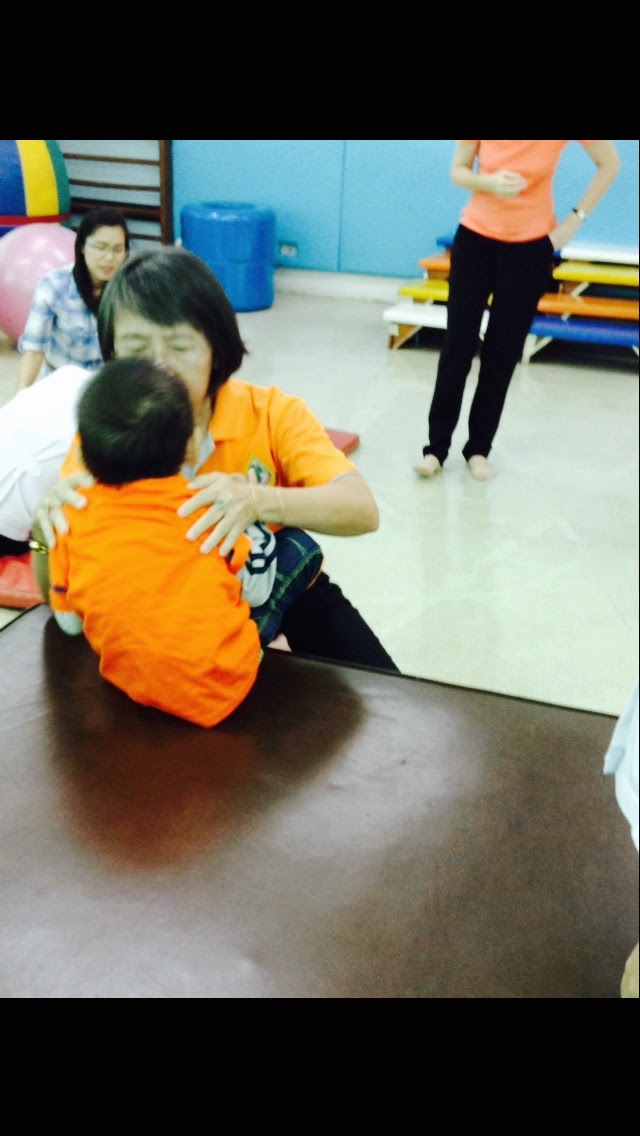
As illustrated by children with cerebral palsy, neurological disorders often cause increased muscle tone - or too much tightness. In the muscles of the arms and legs, spasticity results from increased muscle tone, limiting movement and joint mobility (Verschuren et al.).Therefore, the therapeutic goal of physical therapy for children with cerebral palsy is largely focused around "improving ones ability to walk or perform other functional activities" (Verschuren et al.).
Chiefly, passive stretching is the major component of the children's program at CMU. By definition, passive stretching is when "the stretch is performed by another person and the child does not actively participate"
(Wiart et al.). Notably, this type of stretching is integral to the physical therapy for Hope Home's children. This is because the children who have cerebral palsy at the home, have severe cerebral palsy. The number of controlled muscle movements they are able to perform is extremely limited. Ergo, applied external force is required to complete any stretch.
Foremost, after arriving for our weekly session the physical therapy students started with each child's upper extremities. Initially, a gentle soft tissue massage was completed by each therapist. This was performed to loosen up the desired muscle group and to promote a convivial connection with the child.
Subsequently, each therapist then moved to performing palm extension exercises. These exercises are salient for children with cerebral palsy. For these children, the clenched fists come from the damaged brain sending improper impulses to muscles causing "excess flexion" (Soon et al.). Accordingly, the physical stretching of the palm helps relieve this tension.
Following several minutes of these types of exercises, the students shifted to bicep flexion and shoulder rotation. Overall, in our group this is commonly met with a rousing chorus of grunts, groans and tears. Due to the children's inability to communicate verbally, the reason for the crying cannot be completely understood. The child could be feeling pain resulting from their stuff muscles being elongated. Or if the child has experienced damage to their cerebral cortex, their ability to perceive their world could be hampered (Gerztiman et al) . Therefore, the child could be perceiving a fearful situation.
Following the choir of cries, the physical therapy students focus shifted to the lower limbs. Largely, a similar routine was performed as on the upper extremities. However, the physical therapy students did preform a new type of exercise to each child's legs that was not performed on the child's arms.
Accordingly, prolonged stretching is when "positioning is used to achieve a longer duration stretch of a muscle group (Wiart et al.). Often this type of therapy is completed with the assistance of splints or braces. In respect to our physical therapy session, 3/4 leg braces allowed the physical therapy students to stretch the major lower extremity muscle groups while simultaneously assisting the child with sitting or standing. Overall, there is something exceptional about seeing a child stand who cannot do it individually. It is almost as if you can see the pride fill their eyes and confidence seep out of their pores. I do not believe there is a better education for the students than that image right there.
Not only are these children living models for the students to practice their craft on, but they are also tangible models of life lessons. Walking should not be taken for granted. Siting should not be taken for granted. Life un-assisted should not be taken for granted. Though confined by their disability - they are not defined by their disability. And that in itself may be a lesson for more than just this small student sector of Thailand.
Monday, October 27, 2014
20 days/485 hours/29,100 seconds
There is a reason why the first thing we often ask someone
after we learn their name is where they come from. Where's home? It is because
the notion of "home" is imperative to human life.
Throughout time, writers and scholars alike have all
attempted to define this essential concept. In the second poem of the Four
Quartets, T.S Eliot writes that "home is where one starts from".
Personally, I favour the definition scribed in the book "Honey for a
Child's Heart". In this work, Gladys Hunt raised the question "what
is home?" Her response to this was "[home] is a safe place, a place where
one experiences secure relationships and affirmation. It's a place where people
share and understand each other".
So how does Hope Home fit into that concept? Hope Home is a
safe place. The children that reside there are secure, nurtured and more than
anything - loved. It is a home in the truest sense of the word, just like your
own personal home.
With that in mind, I would like you to envision something.
Imagine you are a boy. Imagine you are ten years of age. Imagine waking up in
the morning, lazily extending your limbs to and fro to shake out the
drowsiness. Then imagine being gently told that in approximately two weeks you
would be moving to a strange city ten hours away. Then imagine being gently
told that you would be making this journey all by yourself with only your few belongings
in tow. Now you can stamp this described visualization as dramatic, absurd or
even unbelievable - but your stamp would be false. For it is believable, I can
attest to that.
Unfortunately, this agonizing story played out at Hope Hope
in the past couple of weeks to an amazing boy. A boy who has experienced such
hardship in his body that has been ravaged by severe cerebral palsy. A boy that
despite his illness mounted against him showed extreme determination and
tenacity in countless scenarios. A boy that still managed to physically move
himself around and hold himself tall - all with limited assistance. A boy who
transformed himself into a beacon of light and a fountain of positive energy. A
boy that though physically confined in a wheelchair the majority of the time,
did not allow his spirit to be contained.
Well amazing boy, if words could drift off this page and
travel on a magical paper airplane through the sky - I would send the following
to you. I wish that your inner strength only grows in the face of the adversity
you are facing. I wish that your happiness does not dim following this storm of
turmoil. I wish that your smile breaks through the oppressive mask that has
been molded by your arduous departure. I wish that you find a small amount of comfort
in knowing you are thought about every single day. Lastly, I wish that in this
short time that has passed you have already impacted someone in your new home.
For in just 20 days/485 hours/29,100 minutes - you impacted me so tremendously.
Monday, October 20, 2014
Wildflower Home Blog 7
Although I wrote a lot about my weekends in the last blogs, eighty percent
of my life in Chiang Mai is determined by my work at Wildflower Home. A
few things have changed at Wildflower Home and with it my tasks have
changed as well. I work in the farm until lunch break. This involves
cleaning pig stables, fastening bank slopes and setting up a vegetable
garden. I like the work there. It is rhythmic and it is dynamic. Your head
is absolutely empty. There is just the sound of your rake hitting the
ground and the smacking sound of the soil giving in. This is accompanied
by the choir of roosters crowing all around you. No deadlines are pressed
but instead you´re just giving your best. You work to your tempo, taking
breaks when ever need them. If it´s not ready, you´ll finish it tomorrow.
I have learned a lot about my physical limits, but I was also surprised by
some of my skills. Skills which I never would have assumed I had. I have
learned that hard work brings people together. The breaks provide a great
opportunity to get to know the members of Wildflower Home better. It gives
you time to hear their stories and to understand why they are at WFH.
Overall, working in the farm is definitely the highlight of my day.
In addition to my work on the farm, I´m teaching English in the afternoon.
This is one activity which is really fun. Beside that, I am doing crafts
and handmade cards. I find that these can be dreary. But the kids provide
a light to the tedium with their running around and playing with our art
supplies. They always seem to be giggling and screaming. Since some
mothers with older kids have left, there are only three kids around two
year’s age. Therefore, there is no nursery currently functioning. Whoever
is around simply watches the cluster of children. Though their presence
makes the card production slightly slower, when a happy two year old jumps
on your lap the interaction brings the biggest smile to your face.
Subscribe to:
Posts (Atom)